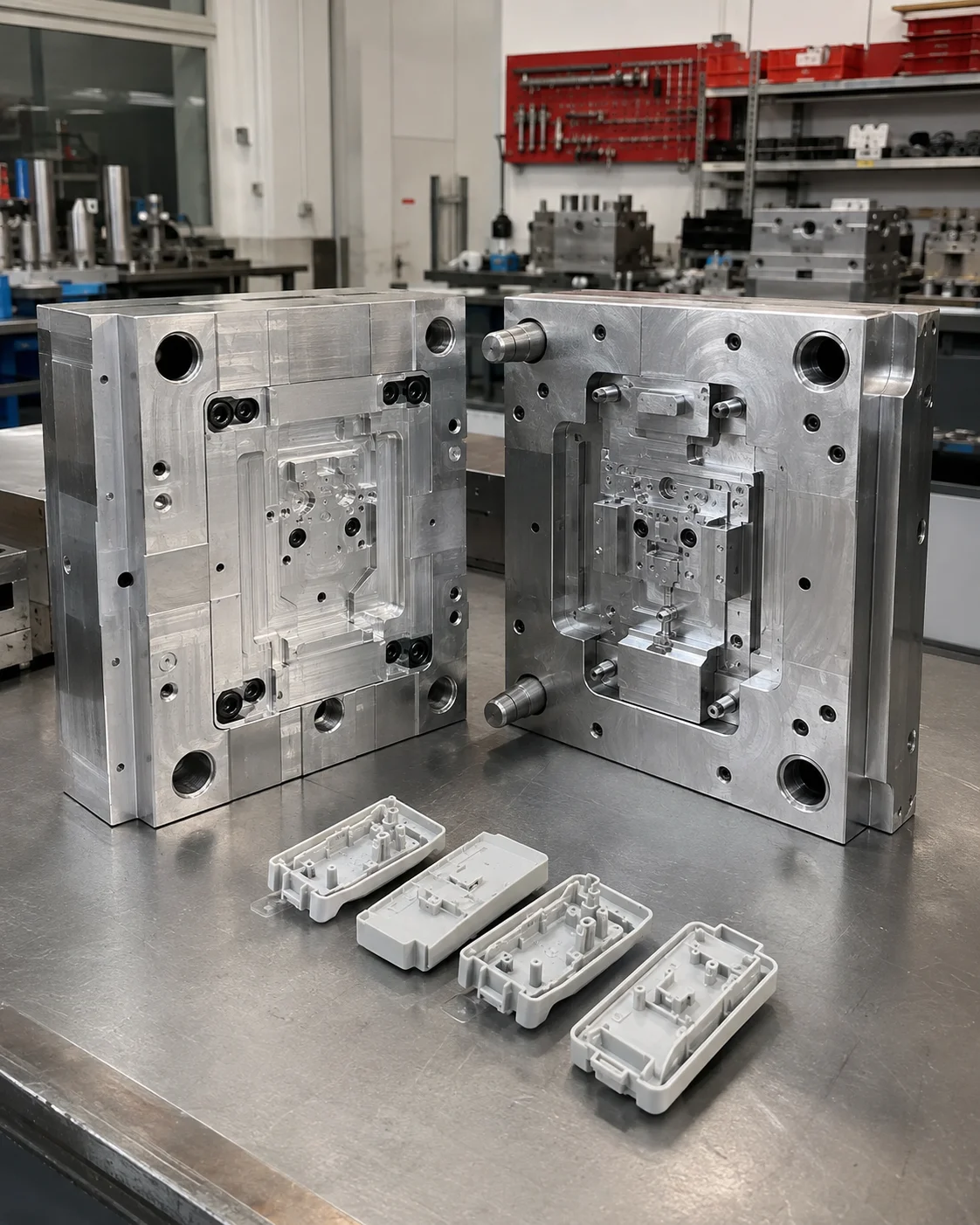
When a prototype includes deep cavities, intricate surface details, undercuts, or difficult-to-machine features, the tooling strategy can become as important as the part design itself. Direct rapid tooling can be efficient for straightforward geometries, but more complicated prototypes may benefit from an indirect approach.
Indirect rapid tooling uses a master pattern to create the mold or tooling needed for prototype production. This additional step can increase the initial process time, but it can also protect the original pattern and provide greater flexibility when reproducing complex geometry.
For product development teams evaluating functional prototypes, appearance models, or low-volume molded parts, understanding when this approach is appropriate can help balance geometry, tooling investment, material requirements, and development schedules.
Why Complex Geometries Can Challenge Direct Rapid Tooling
Complex prototype geometries often contain features that are difficult to reproduce directly in a mold. Deep recesses, intricate contours, thin sections, undercuts, textured surfaces, and small details can increase machining difficulty and require additional tooling mechanisms.
Undercuts, for example, may require slides or lifters to allow the molded part to release from the tool. HordRT notes that external and internal undercuts can add tooling complexity and cost, while suitable parting-line adjustments may sometimes simplify the structure.
For a design that is still evolving, repeatedly modifying a complicated tool can also increase development costs. If several iterations are expected, the ability to preserve a master pattern while producing tooling from it can become valuable.
How the Master Pattern Changes the Tooling Strategy
The fundamental difference between direct and indirect rapid tooling is the position of the master pattern in the manufacturing process.
With an indirect route, the master pattern represents the intended part geometry and is used to create a secondary mold or tool. Once the master pattern has been produced accurately, it can remain relatively protected while the resulting tooling handles the repeated molding process.
This approach is particularly useful when the geometry is difficult to machine directly into conventional tooling materials. A carefully produced master pattern can capture complex curves, fine details, and challenging surfaces before those characteristics are transferred into the prototype tooling.
The method therefore shifts part of the manufacturing effort from directly machining the final mold toward creating an accurate intermediate pattern.
When Is Indirect Rapid Tooling Useful?
Indirect rapid tooling can be considered when prototype geometry is more important than achieving the shortest possible tooling route.
Complex curved surfaces are one example. Automotive components, consumer products, equipment housings, and ergonomic parts may include flowing contours that are difficult to reproduce efficiently through conventional direct machining. A master pattern can provide a controlled reference for transferring these surfaces into the subsequent tooling process.
Highly detailed features are another consideration. When a prototype requires small ribs, surface textures, decorative details, or complicated transitions, protecting the master pattern can reduce the risk of repeatedly damaging or modifying the original geometry during prototype development.
It can also be useful when different prototype materials need to be evaluated. HordRT’s rapid tooling capabilities support production-grade thermoplastics including ABS, PC, PC/ABS, PP, PA, POM, PMMA, PBT, TPE, TPU, and PPS. The ability to evaluate different materials can be important when the objective extends beyond visual approval to functional and assembly testing.
Hard or Soft Tooling for Different Prototype Objectives
Indirect rapid tooling does not necessarily mean every project requires the same type of secondary tool. The appropriate tooling route depends on geometry, expected quantity, material, surface requirements, and the purpose of the prototype.
For projects requiring greater durability and repeated prototype production, a harder tooling solution may be appropriate. For simpler geometries or limited testing, softer tooling can provide a more economical route.
This distinction matters because prototype development is rarely just about producing one physical part. Engineering teams may need multiple samples for dimensional inspection, assembly testing, functional validation, customer evaluation, or material comparison.
HordRT approaches rapid tooling according to these project variables rather than treating every prototype as the same tooling problem. Its current rapid tooling process evaluates CAD data, resin, production volume, tolerance, and expected mold life before proceeding with mold design.
Where HordRT Adds Value to Complex Prototype Projects
The effectiveness of an indirect rapid tooling strategy depends heavily on engineering preparation. A master pattern alone cannot compensate for an unsuitable parting line, poor draft design, inadequate cooling, or difficult ejection conditions.
HordRT provides DFM analysis before tooling production to identify potential manufacturing risks and recommend practical design changes. Its tooling workflow includes mold design, machining, fitting, assembly, mold trials, and sample validation under one coordinated process.
The company also combines CNC machining, EDM, wire cutting, precision finishing, injection molding, and inspection capabilities within its manufacturing operation. For projects involving difficult geometries, this integrated workflow can reduce unnecessary handoffs between engineering and manufacturing stages.
HordRT reports a typical rapid tooling lead time of 5 to 10 working days after design and DFM details are approved, although actual timing depends on factors such as geometry, tooling material, mold structure, finish, and inspection requirements.
Its shared mold base system can further reduce tooling investment for suitable projects. HordRT states that shared mold bases can reduce tooling costs by 30% to 50% depending on the application.
Choosing the Right Route Before Machining Begins
Indirect rapid tooling is not automatically the better choice for every prototype. If the geometry is relatively simple and the design is stable, direct rapid tooling may provide a shorter and more economical path. If the design is expected to change significantly, the additional master-pattern stage may also reduce its practical value.
The key is to evaluate the entire development objective rather than comparing tooling methods only by initial quotation. Geometry complexity, expected iterations, prototype quantity, surface requirements, material selection, mold life, and future production plans should all be considered together.
For complex prototype geometries, the master pattern can serve as a stable reference between design intent and prototype production. When combined with DFM analysis and controlled tooling manufacturing, indirect rapid tooling can provide a practical route for testing difficult designs before committing to longer-term production tooling.
For teams developing products with demanding geometry, HordRT offers rapid tooling, injection molding, engineering analysis, inspection, and low-volume production through a coordinated manufacturing workflow. Sharing the CAD model, material requirements, expected quantity, and target timeline at the quotation stage allows the tooling route to be evaluated according to the actual project requirements rather than a generic prototype specification.