Payment processing, refrigerated stock, security systems, and essential lighting can all lose power during the same outage. A business rarely needs every appliance running at once, but the services that protect stock, staff, and transactions deserve a defined backup arrangement. Continuity begins with those functions, rather than the building’s total connected load.
A 30 kVA generator can suit a modest commercial installation whose essential demand fits its operating limits. A 45 kVA generator provides a different capacity option, rather than an automatic upgrade in business value. The practical benefit of either size depends on a critical-load schedule that reflects actual operation and future needs.
Critical Loads Establish the Useful Capacity
Essential loads must be separated from equipment that can remain off until normal electricity returns. A restaurant might prioritize refrigeration and lighting while postponing other tasks. An office might retain selected communication equipment and access controls. Each arrangement produces a different demand profile, even if the premises occupy similar floor space.
The kVA rating describes apparent power, while equipment also consumes active power measured in kW. Power factor connects these quantities. The specification for a 30 kVA generator application therefore records both kW and kVA alongside the intended operating duty. The selected package’s declared active-power rating and duty govern actual operation.
Starting demand can exceed normal running demand, especially where pumps, compressors, or ventilation motors are involved. Simultaneous starts can cause a brief voltage or frequency dip. Staged connection reduces the size of that single event, although the complete package must still handle the most demanding permitted start.
A 45 kVA generator becomes relevant if the measured load, starting sequence, or planned expansion requires greater capacity. Spare capacity has a purpose when tied to a defined future load. Excessive oversizing adds purchase and installation costs without necessarily protecting more useful business activity.
The Electrical Component Shapes Supply Quality
An engine supplies mechanical rotation, while an alternator converts that rotation into electrical energy. For a 30 kVA generator application, the alternator specification needs to state the required electrical output, voltage, frequency, power factor, and operating duty. Its performance must be assessed together with the engine and connected equipment.
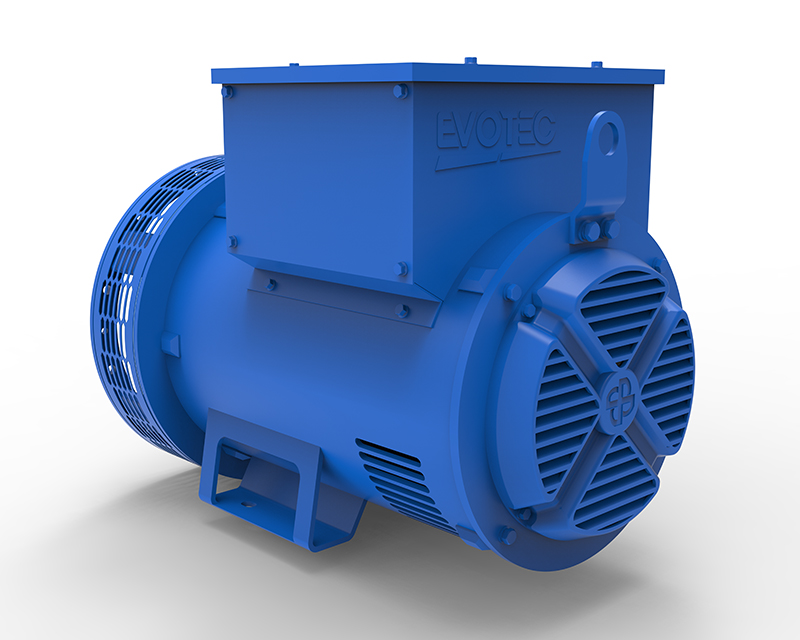
For that electrical component, EvoTec Power’s EVO188 industrial alternator family lists a 25–54 kVA range in its 50 Hz continuous-rating field. The family is presented for integration with systems including the 45 kVA generator category. Selection within the family range matches a variant’s continuous rating to sustained commercial demand.
Voltage regulation and waveform quality address different disturbances. An automatic voltage regulator adjusts excitation to control voltage as demand changes. EVO188’s ETC-1 regulator controls terminal voltage, while its two-thirds winding pitch suppresses specified harmonic components. Suitability for nonlinear loads depends on the alternator configuration and load characteristics.
Nonlinear equipment can draw current in pulses rather than a smooth sinusoidal pattern. Resulting harmonics affect voltage quality and heating, so compatibility depends on the connected load as well as alternator construction. Sensitive electronics require suitable supply conditions throughout the transfer and restart sequence, including any necessary temporary battery support.
Electrical losses become heat, which the cooling airflow must carry away. Part of the mechanical input covers conversion losses before electrical power reaches the load; fuel consumption reflects engine characteristics at the actual operating point. EVO188’s shorter structure and ventilation design address installation space and heat removal; blocked airflow can undermine those benefits.
Class H identifies the insulation’s thermal class; temperature rise, ambient conditions, cooling, and alternator rating govern operation. A compact canopy still needs adequate ventilation. Clear maintenance access and a suitable cooling arrangement support sustained running when an outage lasts longer than expected, without turning a nominal rating into an unconditional guarantee.
Operating Schedule Sets the Ownership Burden
Occasional emergency use and regular generation create different equipment responsibilities. A permanently installed 30 kVA generator can be available throughout the year, provided its starting, transfer, fuel, and maintenance arrangements remain ready. Infrequent operation does not remove the need to inspect or exercise the complete system. An outage drill also exposes switching delays and confirms whether essential services restart in the intended order.
Ownership gives the business control over maintenance timing and installation choices, while bringing purchase, storage, and servicing costs. Renting a 45 kVA generator may suit a temporary project, seasonal requirement, or repair period. Rental availability and operating terms affect that decision; these are complete-system arrangements, outside an alternator manufacturer’s component scope.
EvoTec Power‘s service guidance calls for correct operation and regular maintenance. The maintenance plan needs named responsibilities, access to service points, and records of inspections and running hours. Local operating conditions matter because dust, moisture, or obstructed cooling paths can change the demands on equipment between scheduled visits.
Keep Essential Business Functions Ready
Alternator selection for a 30 kVA generator application requires an alternator matched to voltage, frequency, phase arrangement, continuous rating, and load characteristics. The alternator for a 45 kVA generator needs compatible prime mover interfaces and adequate capacity. EvoTec Power’s alternator specifications provide the electrical basis for component matching. The final installation must keep the chosen business functions available, with ownership of testing, servicing, and restart arrangements assigned.