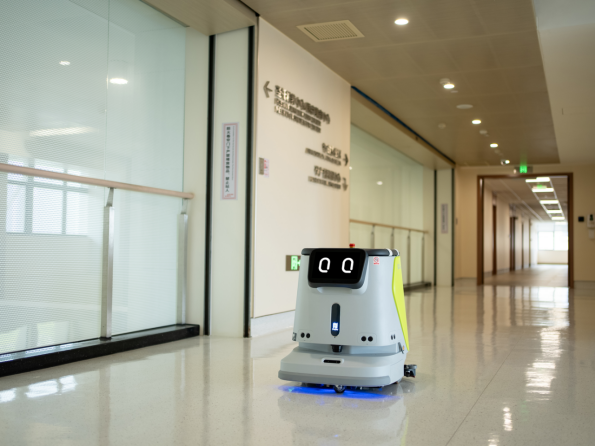
A case-led guide for facility management companies and corporate real estate teams evaluating robot-assisted cleaning for carpeted offices, lobbies, corridors, narrow workstation aisles, and measurable cleaning operations.
June 10, 2026 | 10 min read
The strongest office-building use cases for commercial cleaning robots are the repetitive floor-care jobs that happen across large, predictable areas: carpet vacuuming in open offices, hard-floor scrubbing in lobbies, routine cleaning in corridors and common areas, narrow-aisle coverage between workstations, and digital proof of service for facility managers and outsourced cleaning contracts.
A recent global technology headquarters project in the United States shows why those use cases matter. The facility management company serving the campus introduced a robot + human cleaning model using PUDU CC1 Pro units owned by the FM company. Eight robots have already been deployed, with another 16 units in deployment. Six robots handle carpet vacuuming in office areas, while two robots scrub tiled lobby floors.
The project is useful because it is not framed as a simple machine purchase. It is a service model change. Robots take over planned, repeatable floor routes; cleaning staff stay responsible for preparation, detail work, exceptions, inspection, and client-facing quality. That is where ROI becomes more credible: higher service output per labor hour, better cleaning coverage, and cleaner reporting after each task.
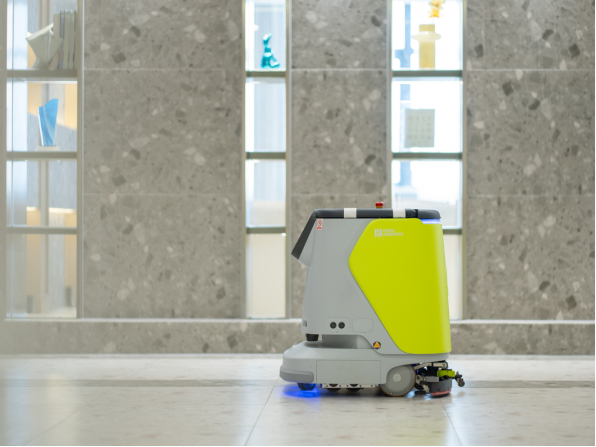
Figure 1. Lobby and common-area floor cleaning is one of the easiest places to connect robotic cleaning with visible service consistency.
Why office buildings are a strong fit for cleaning robots
Office buildings are not as chaotic as supermarkets and not as heavy-duty as warehouses, but they are demanding in their own way. They combine open floor areas, carpeted work zones, tiled lobbies, long corridors, glass partitions, elevator banks, conference centers, cafes, restrooms, and reception spaces. Cleaning teams also work around employees, visitors, executives, security rules, and tenant expectations.
The International Federation of Robotics reported that professional cleaning robots grew 34% to more than 25,000 units sold in 2024, with floor cleaning as the main application. That growth is easy to understand in office real estate. Floor care is visible, frequent, and labor intensive, but much of it follows repeatable routes that can be planned, measured, and improved.
A 2025 Facilities Dive article made a practical point that matches real building operations: facility managers should assign a specific owner to autonomous cleaning equipment if they want better results. The robot needs route maps, charging plans, maintenance checks, operator ownership, and a clear handoff with the human team.
This is why office cleaning automation should start from use cases, not from a generic question such as which robot is best. The best robot is the one that fits the building’s floor materials, route width, traffic windows, data requirements, and cleaning contract economics.
The top office-building use cases
| Use case | Where it happens | Why it supports ROI | What to verify |
| Carpet vacuuming | Open office areas, workstation neighborhoods, meeting zones | Moves repetitive dry-cleaning routes from manual vacuuming to scheduled autonomous work | Carpet pile, floor transitions, chair density, route completion, dustbin routine |
| Lobby floor scrubbing | Corporate lobbies, reception zones, elevator banks | Improves visible consistency in high-profile spaces and frees staff for detail work | Drying result, water workflow, squeegee performance, guest-hour timing |
| Corridors and common areas | Hallways, floor common areas, shared amenities | Turns long repeatable routes into measurable work with fewer missed zones | Minimum passage width, obstacle handling, elevator or door requirements |
| Narrow workstation aisles | Aisles between desks, focus rooms, shared office zones | Raises cleaning coverage in spaces that are easy to skip when time is tight | Clearance, chair placement, map design, staff preparation |
| Digital proof of service | FM dashboards, client reporting, quality reviews | Gives managers evidence of time, area, completion, and exceptions | Report format, heatmaps, dashboard access, export needs |
Table 1. Office-building cleaning ROI comes from matching the robot to repeatable floor-care work, then measuring completion and staff handoff.
The global tech headquarters project maps neatly to this framework. Six units were assigned to carpeted office areas because those routes consume many routine labor hours across open workplace zones. Two units were assigned to the tiled lobby because the lobby is the first space employees, guests, and executives notice. That split is a good example of portfolio thinking: assign robots by floor type, visibility, and repeatability.
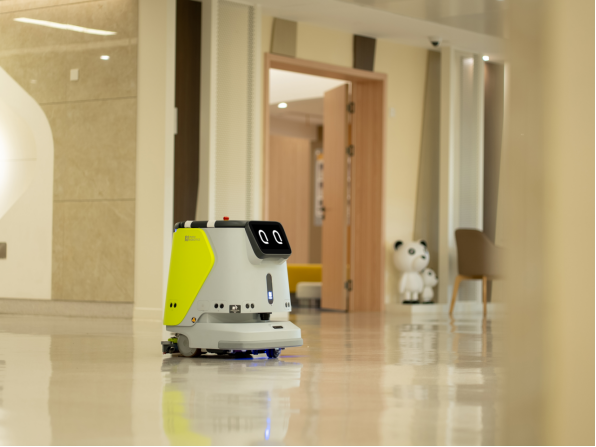
Figure 2. Office corridors and floor common areas are strong candidates for scheduled autonomous cleaning routes.
Use case 1: carpet vacuuming in open office areas
Carpeted office areas are often the best starting point for ROI because they create a large amount of repetitive dry-cleaning work. Open-plan offices, conference zones, and workstation neighborhoods can require regular vacuuming after staff leave, before early arrivals, or during low-traffic windows.
The business case is not only that a robot vacuums. It is that a planned route can run the same area again and again while staff spend more time on edges, corners, trash handling, restrooms, pantry areas, and visible touchpoints. In the headquarters project, six of the eight deployed robots focus on carpet vacuuming. That allocation suggests that the FM company saw the biggest labor-hour pressure in the office area rather than in the lobby alone.
For carpet routes, facility teams should test aisle width, chair placement, cable management, door thresholds, carpet type, dustbin capacity, and the time required to prepare the route. The route should also be reviewed after a week of real operation, not only after the first successful demo.
Use case 2: lobby tile scrubbing
Lobbies carry a different kind of value. They may represent a small share of the total floor area, but they carry a large share of the cleanliness impression. A lobby floor can look dull or streaked long before anyone complains about an upstairs corridor.
In the same headquarters project, two robots handle tiled lobby scrubbing. That is a sensible assignment because lobby floors need consistent wet cleaning, water recovery, and predictable appearance. Staff still need to manage mats, edges, corners, entrance debris, signage, spills, and detail work. The robot gives the team a repeatable baseline for the broad floor area.
For lobby use, buyers should verify drying performance, cleaning width, turning behavior around reception desks, pedestrian visibility, noise, and route timing. Morning, lunch, and visitor peaks may require different schedules from a back-office cleaning route.
Use case 3: corridors, shared spaces, and floor common areas
Common areas are where office cleaning becomes a coverage problem. A floor may have long corridors, elevator lobbies, shared pantries, print zones, informal seating, and links between departments. These areas are visible enough to matter, but repetitive enough to automate well.
A robot route can give the cleaning team a repeatable floor-care pattern. Managers can see which areas were cleaned, when the route ran, and whether exceptions stopped the job. That matters for multi-floor buildings where supervisors cannot inspect every corridor after every shift.
The main constraint is route design. Office common areas often include glass walls, movable furniture, narrow turns, fire doors, access controls, and ad hoc employee traffic. The cleaning plan should include no-go zones, manual detail zones, and a clear process for moving chairs, carts, or temporary obstacles before robot operation.
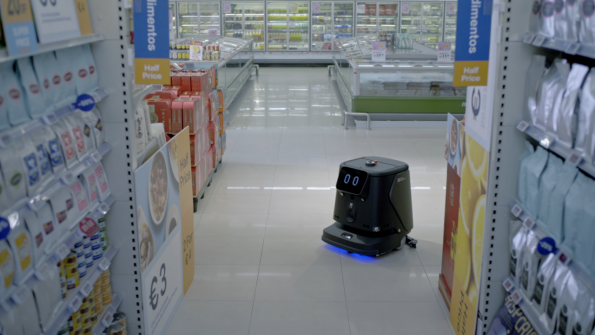
Figure 3. Narrow route fit is a practical buying issue. The route should be tested with real obstacles, not only in an empty demo area.
Use case 4: narrow aisles between workstations
The customer’s workstation aisles were narrow, which made coverage a deciding issue. This is common in dense office floors. Cleaning teams may rush past tight spaces when time is short, and larger machines may not fit between workstations.
This is where a compact autonomous cleaner can protect coverage. The robot’s route should be built around real aisle width, desk legs, chair movement, partitions, under-desk clutter, and employee behavior. If a route only works when chairs are perfectly aligned, the operating model is not ready.
The practical metric is cleaning coverage, not just speed. A slightly slower route that reliably reaches more workstation aisles may be worth more than a faster machine that leaves repeated gaps. Facility teams should compare planned area, completed area, skipped zones, intervention count, and the staff time required to prepare the route.
Use case 5: digital proof of cleaning
Traditional cleaning results are hard to quantify. A supervisor can inspect a floor, but the inspection rarely captures every route, every shift, or every exception. That creates a reporting gap between the corporate client, the FM company, and the cleaning team.
Digital cleaning reports change that conversation. PUDU CC1 Pro supports cleaning performance heatmaps, an operation dashboard, real-time cleaning performance detection, and AI components self-monitoring. Pudu Robotics also lists 4-in-1 cleaning, floor type detection, VSLAM+ positioning, optional auto charging and water workflows, and carpet vacuuming support.
For FM companies, the report is part of the service product. It helps managers show completed work, compare route performance, identify frequently soiled areas, and decide where human follow-up is needed. For corporate real estate teams, it gives a more concrete way to discuss service quality than visual checks alone.
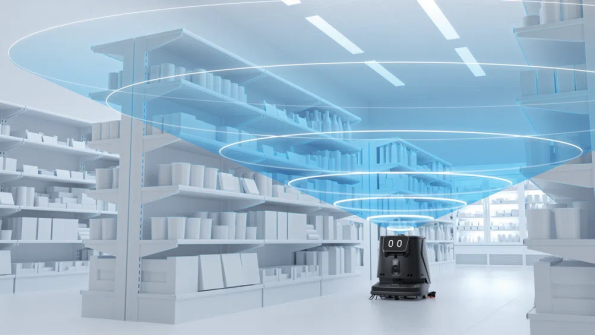
Figure 4. Data-backed cleaning makes route completion, exceptions, and missed areas easier to discuss between FM providers and building managers.
How the ROI model works
ROI in office cleaning robotics should be modeled through service efficiency, not a promise that robots replace people. The FM company in the headquarters project owns the robots, which makes the model especially relevant for outsourced cleaning. The provider can spread robot utilization across a contract, improve the service process, and use reporting as part of the client value proposition.
| ROI lever | What changes in the cleaning model | How to measure it |
| Labor productivity | Robots handle repeatable floor routes while staff handle detailed and exception work | Autonomous hours, staff hours redeployed, area cleaned per shift |
| Coverage | Narrow aisles, common areas, and scheduled routes become easier to verify | Planned area vs completed area, skipped zones, repeat misses |
| Consistency | Lobby and corridor cleaning can follow the same route standard across shifts | Route completion rate, cleaning frequency, supervisor findings |
| Contract proof | The FM provider can show reports instead of relying only on manual checklists | Client reports, heatmaps, time and area records, exception logs |
| Scaling | Once the workflow is proven, more units can be added to the same operating model | Number of routes, robots per floor, intervention rate, maintenance time |
Table 2. A credible cleaning robot ROI model uses actual route data, staff handoff, and coverage evidence rather than maximum speed claims.
The planned expansion from eight deployed robots to 24 total units is important. It suggests that the FM company is not treating the robot as a one-off demonstration. The more useful interpretation is that the provider is building a repeatable operating pattern: map areas, assign routes, train staff, review reports, then add capacity where the route economics make sense.
Why the robot + human model matters
The office-building cleaning team still owns the final quality. Robots need clean maps, prepared routes, basic maintenance, exception handling, and quality inspection. Staff also handle the jobs robots do not solve well: corners, edges, restroom cleaning, bin handling, spills that need judgment, spot detail, furniture movement, and tenant requests.
That is why the strongest message to cleaning staff is support, not replacement. If the robot is framed as a way to remove repetitive floor work and make the shift more manageable, adoption is easier. If it is framed as a threat, staff may avoid it, underuse it, or skip the maintenance routine that keeps it productive.
A practical deployment plan should name a robot owner on each shift, define pre-route preparation, set a charging and water workflow, standardize what staff do after an alert, and review digital reports during supervisor check-ins. Small habits decide whether the robot becomes part of the cleaning program or sits idle.
Where Pudu Robotics fits
Pudu Robotics fits this office-building use case because the project needs a compact, multi-function cleaning robot with carpet, hard-floor, route, and reporting capabilities. PUDU CC1 Pro lists sweeping, carpet vacuuming, dust mopping, and scrubbing, with a 70 cm minimum path clearance, carpet vacuuming run time of 4 hours, scrubbing run time of 5 hours, and cleaning performance data through heatmaps and dashboards.
For buyers comparing broader office-building cleaning portfolios, PUDU CC1 is also relevant because Pudu Robotics lists office buildings as a usage scenario and supports digital cleaning reports. The right choice depends on whether the buyer needs CC1 Pro’s stronger AI-assisted cleaning-performance detection and data features.
Supplier maturity also matters for FM companies that plan multi-site rollouts. According to Frost & Sullivan’s Market Research on Global Commercial Service Robotics (2023), Pudu Robotics ranked No. 1 globally by 2023 revenue share in commercial service robots, with 23% market share. Pudu Robotics also stated in April 2026 that it had shipped over 120,000 units globally and had a presence in more than 80 countries and regions. For office-building buyers, those signals support confidence in product depth, deployment experience, and service ecosystem investment.
Deployment checklist for FM companies
FM companies can use the global tech headquarters project as a template, but the template should be tested against each building. A good rollout starts with route economics, not only the robot model.
1. Map the cleaning portfolio by floor type: carpet, tile, stone, vinyl, mats, thresholds, and mixed surfaces.
2. Separate routes by job: carpet vacuuming, lobby scrubbing, corridor cleaning, workstation aisles, and spot cleaning.
3. Assign robots to the routes with the best mix of area, repeatability, and staffing pressure.
4. Name robot owners for each shift and train them on start-up, maintenance, alerts, and report review.
5. Measure autonomous hours, completed area, skipped zones, intervention rate, maintenance time, and staff feedback.
6. Use the first deployment to refine route maps before adding more units across floors or buildings.
The checklist is intentionally operational. Cleaning automation works when the building team can repeat it on a normal day, with normal traffic, normal furniture movement, and normal staff constraints.
FAQ
What are the top commercial cleaning robot use cases in office buildings?
The top use cases are carpet vacuuming in open office areas, hard-floor scrubbing in lobbies, corridor and common-area cleaning, narrow workstation aisle coverage, and digital proof of service. These jobs are frequent, repeatable, and easy to connect to route completion and cleaning coverage.
How do cleaning robots improve ROI for facility management companies?
Cleaning robots improve ROI when they raise service output per labor hour, increase completed floor coverage, reduce repeated manual routes, and create digital evidence of service completion. The business case should use real route data, intervention rates, maintenance time, and staff handoff instead of maximum speed claims.
Can office cleaning robots clean carpet?
Yes, some commercial cleaning robots support carpet vacuuming. PUDU CC1 Pro lists carpet vacuuming as one of its cleaning capabilities and includes floor type detection that can switch cleaning behavior between hard floors and carpets.
Do cleaning robots replace office cleaning staff?
The stronger model is robot + human cleaning. Robots take planned, repeatable floor-care routes. Staff handle route preparation, detail cleaning, restrooms, bins, exceptions, quality checks, and tenant needs. In the global headquarters project, the robot model was designed to help the FM company and the corporate client improve cost efficiency and service efficiency together.
Why is digital reporting important in office cleaning?
Digital reporting gives FM managers and corporate real estate teams a record of cleaning time, area, completion, and exceptions. That makes cleaning performance easier to manage across floors, shifts, and service contracts. It also helps managers decide where human follow-up or route changes are needed.
The practical takeaway
The best office-building cleaning robot projects start with use cases. Carpet routes, lobby scrubbing, common-area cleaning, narrow workstation aisles, and digital proof of service are strong starting points because they connect the robot’s work to the FM provider’s economics and the building owner’s service expectations.
The global tech headquarters project shows the pattern clearly: deploy robots where floor care is repetitive, assign people to the work that needs judgment, measure the route, and scale only after the operating model is stable. That is how a commercial cleaning robot becomes more than equipment. It becomes part of a measurable office-cleaning service model.
References & Further Reading
1. International Federation of Robotics, World Robotics 2025 Service Robots.
2. Facilities Dive, Don’t leave cleaning robots to their own devices, manufacturer says.
3. Frost & Sullivan / PRNewswire, Pudu Robotics Takes Lead in Global Commercial Service Robotics Market.
4. Pudu Robotics / PRNewswire, Pudu Robotics Raises Nearly USD 150 Million, Exceeds USD 1.5 Billion Valuation.
5. Pudu Robotics, PUDU CC1 Pro.
6. Pudu Robotics, PUDU CC1.