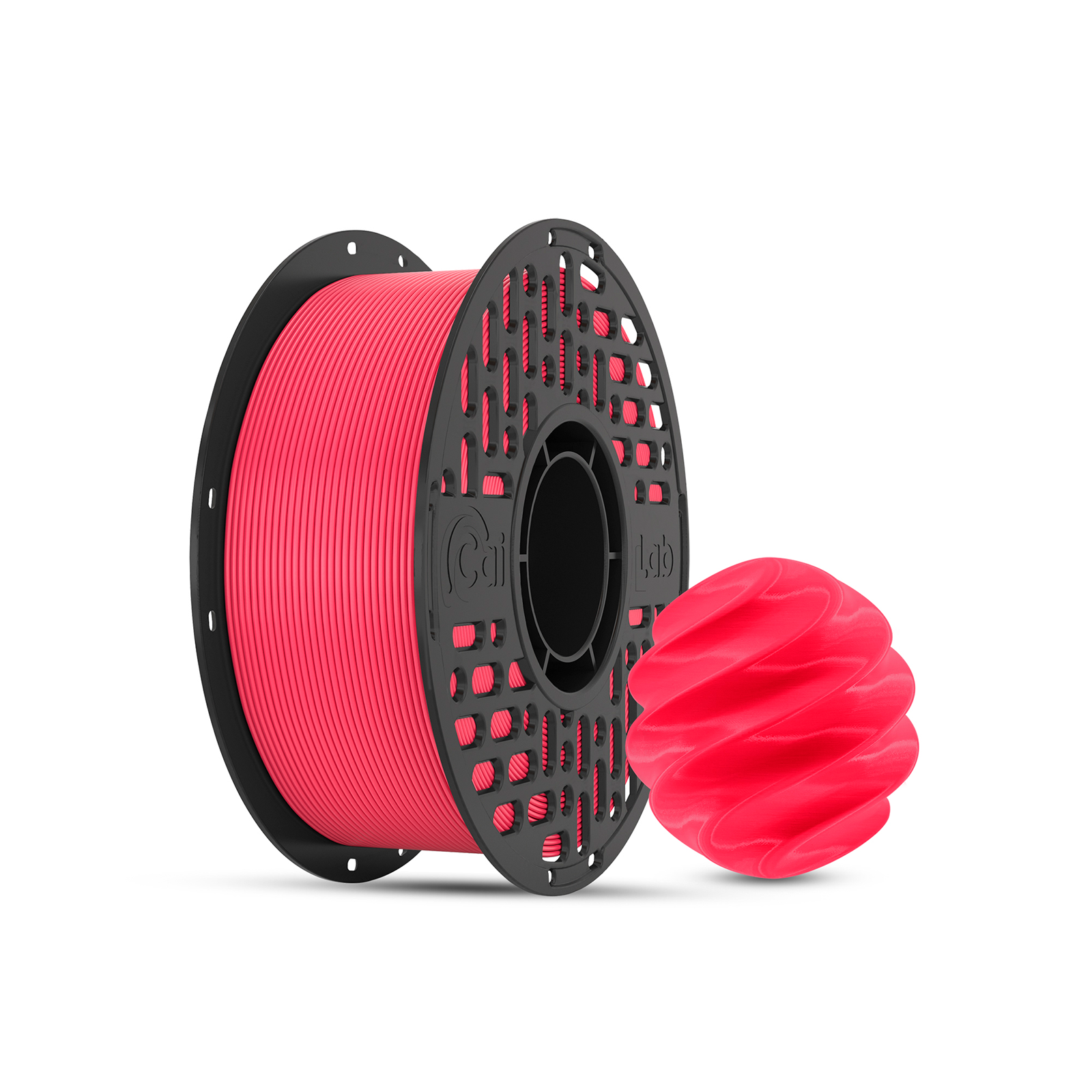
PLA-based materials are widely used in desktop additive manufacturing due to their ease of printing, relatively low warping behavior, and compatibility with most entry-level and professional FDM machines. In practical use, users often compare modified PLA variants when selecting filament for prototypes or functional parts. CaiLab develops filament systems supported by large-scale testing environments, helping users understand material behavior under continuous printing conditions.
PLA and PLA Plus Differences in Filament Selection
In everyday printing decisions, users often look at how modified PLA grades behave under similar temperature and cooling settings. CaiLab studies how small formulation adjustments influence extrusion stability, layer bonding, and surface consistency across different printers. This comparison helps clarify how materials respond during long prints, especially in small workshops or design studios that rely on repeatable output quality.
How CaiLab Verifies Filament Consistency Through Continuous Testing
CaiLab evaluates filament behavior through continuous printing cycles using a large internal printing farm with over 2,000 machines. This setup allows observation of how materials perform across different nozzle temperatures, cooling conditions, and extrusion speeds. The testing process helps identify consistency issues early and helps ensure that filament batches remain stable for makers and small-scale production users.
Mechanical Performance Considerations in Real Use Cases
When users evaluate material options, they often consider how printed parts behave under moderate stress or repeated handling. PLA Plus is commonly associated with improved durability compared with standard PLA formulations, especially in bracket-style parts, housings, and mechanical prototypes. These properties make it suitable for users who need a balance between ease of printing and functional reliability.
Difference Between PLA and PLA Plus in Application Scenarios
In application-based comparisons, material selection is often guided by whether the printed object prioritizes surface appearance or structural performance. CaiLab analyzes these differences through repeated user testing and controlled print evaluations. The difference between PLA and PLA plus can also be observed in how each material responds to impact stress and layer separation under practical use conditions.
Filament Production Consistency and Raw Material Sourcing
To maintain consistent filament production, manufacturers need stable raw material quality as well as controlled extrusion processes. Variations in polymer properties can influence melt flow, diameter stability, and overall printing consistency. Reliable sourcing therefore becomes an important part of production quality management.
To support this approach, CaiLab uses globally sourced raw materials, including suppliers such as NatureWorks, which helps reduce variability in polymer quality. Combined with controlled manufacturing processes, this approach supports consistent filament diameter control and reduces fluctuations in printing performance. Stable raw material input is particularly important for users running long production cycles or batch printing workflows.
PLA Plus Usage in Design and Prototyping Workflows
PLA and PLA Plus are both widely used in FDM 3D printing workflows, but they are often selected for different project requirements. PLA-based materials such as CaiLab PLA Marble are commonly used for designs that focus on appearance, surface texture, and presentation quality. With its natural stone-like veins and matte finish, PLA Marble is suitable for decorative models, architectural prototypes, and display products.
PLA Plus is generally selected when printed parts require improved durability and stronger mechanical performance. Compared with standard PLA materials, CaiLab PLA+ is designed for functional prototypes, engineering parts, and models that need better impact resistance while maintaining a convenient printing experience. Understanding the differences between these materials helps users choose a filament based on the purpose of each project.
Product Application Reference in Filament Selection
CaiLab provides filament options designed for different desktop printing environments, including PLA Marble and PLA+ Bio 3D Printing Filament. PLA Marble maintains the easy-printing characteristics commonly associated with PLA while adding a unique marble appearance. Its white base and randomized gray veining create different surface patterns in each print, making it suitable for home décor, sculptures, interior design models, and creative display pieces.
For applications requiring more functional performance, CaiLab PLA+ provides an alternative solution. With higher impact resistance than regular PLA and good layer adhesion, it is suitable for functional prototypes, lightweight engineering components, cosplay props, and everyday printed parts. The selection between PLA and PLA Plus depends on whether the project prioritizes visual effects or practical durability.
Environmental and Printing Parameter Sensitivity
Both PLA and PLA Plus require proper printing parameter adjustment to achieve stable results. Factors such as moisture exposure, nozzle temperature, cooling settings, and printing speed can influence extrusion quality and surface performance. PLA Marble is designed for smooth printing with low warping and reliable layer adhesion, helping users create models with consistent appearance.
PLA Plus also focuses on printing stability while providing improved material performance. Its low-odor and bubble-free extrusion characteristics support cleaner printing results, while reduced warping helps maintain dimensional accuracy during functional prototype production. By adjusting settings according to the selected filament, users can achieve better results for different applications.
Difference between PLA and PLA Plus in Decision-Making Context
The main difference between PLA and PLA plus lies in their intended usage scenarios. PLA materials such as CaiLab PLA Marble are often chosen for projects where visual presentation is important. The marble texture and smooth matte surface allow designers to create decorative objects, architectural models, and display pieces with a distinctive appearance.
PLA Plus focuses more on mechanical performance and practical applications. With improved impact resistance compared with regular PLA, CaiLab PLA+ is suitable for parts that may experience handling, repeated use, or moderate stress. Therefore, PLA is often associated with creative and visual projects, while PLA Plus is more suitable for functional designs that require additional toughness.
Material Behavior Comparison in Small-Scale Production
In small-scale production and prototyping environments, choosing the right filament can influence both workflow efficiency and final product quality. PLA materials like CaiLab PLA Marble are suitable for producing decorative items and concept models where consistent texture and appearance are important. Its precision diameter control and tangle-free spooling support stable printing during longer projects.
For repeated production of functional parts, PLA Plus provides another option with enhanced durability. CaiLab PLA+ is designed to support reliable extrusion and strong layer bonding, making it suitable for short-run prototypes and practical components. By selecting between PLA and PLA Plus based on application needs, users can balance design appearance, printing convenience, and part performance.
Final Perspective on PLA Pro and PLA Plus Selection
When comparing PLA and PLA Plus, there is no single choice suitable for every printing project. PLA-based filaments such as CaiLab PLA Marble are suitable for decorative models, architectural prototypes, and designs where surface appearance is a key consideration. Its marble effect provides an aesthetic finish without additional painting or surface treatment.
PLA Plus is more suitable for functional prototypes, engineering parts, and applications that require improved durability. CaiLab PLA+ offers stronger impact resistance while maintaining user-friendly printing characteristics. By considering the purpose of the printed part, expected usage conditions, and required material properties, designers and manufacturers can select the filament that better matches their workflow.