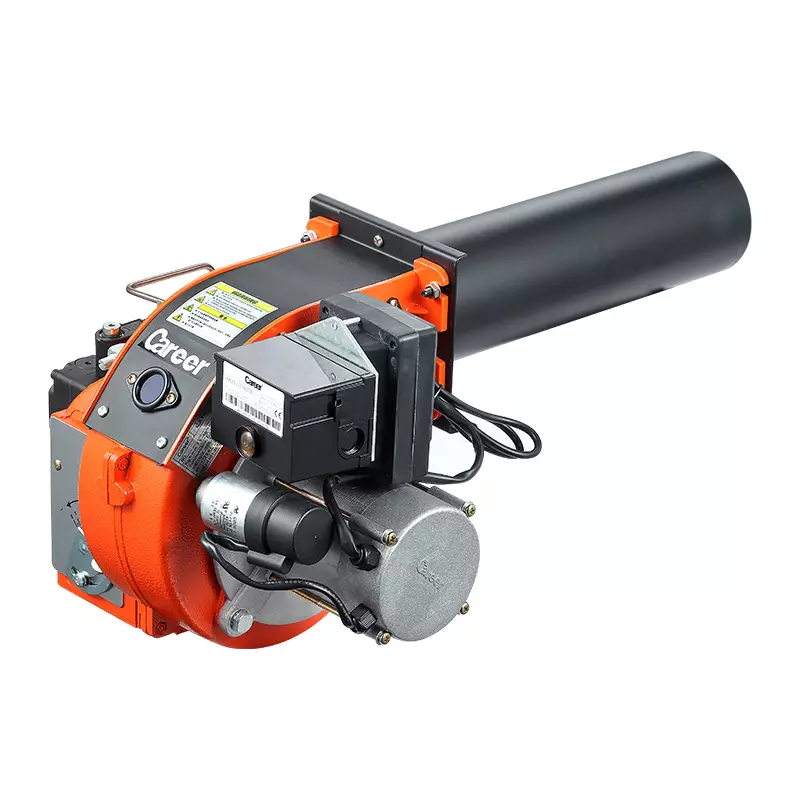
Industrial heating systems face a dilemma: maintaining stable thermal output while responding to fluctuating demand. Traditional manual oil burners require constant operator adjustment, creating inefficiency gaps where flame intensity either overshoots or undershoots the target temperature.
Automatic oil burners respond by introducing sensor-driven feedback and autonomous combustion management, transforming heating from a reactive, labor-intensive process into a precision-controlled operation. Understanding how these systems achieve that control reveals why they’ve become essential in modern thermal applications.
The Control Challenge in Industrial Oil Heating
Manual oil burner operation inherently lags behind demand changes. An operator observes a temperature drop, adjusts the burner manually, and waits for the system to respond—a cycle that typically takes minutes.
During this interval, the facility either runs too cool or, when correcting upward, overshoots and wastes fuel. Over a shift or production cycle, these oscillations accumulate significant thermal waste and create inconsistent conditions for downstream processes.
Beyond adjustment lag, manual control introduces operator fatigue and variability. Different personnel apply different strategies, and night-shift monitoring often becomes perfunctory. Energy output becomes uneven, thermal cycling increases mechanical stress on piping and equipment, and precise temperature maintenance—critical for certain industrial applications—becomes nearly impossible. An automatic oil burner eliminates this human bottleneck by replacing manual judgment with continuous sensor input and automated response logic.
How Automatic Combustion Management Works
Automatic oil burner systems rely on three core components working in concert: fuel delivery control, combustion air supply adjustment, and continuous monitoring feedback.
When the system powers on, the burner ignites and establishes a reference flame signal, typically detected via a flame rod that measures ionization current across the ignition electrodes. This signal confirms combustion is stable before the system transitions to full operation.
Throughout operation, temperature sensors in the heating medium (water, oil, or air) feed real-time data back to the burner’s control module. If outlet temperature drops below setpoint, the control unit increases fuel pump pressure and modulation valve opening simultaneously, raising flame intensity.
Conversely, when temperature rises above setpoint, the system reduces both parameters proportionally. This closed-loop response happens continuously, not once per operator decision, allowing the system to anticipate and correct thermal drift within seconds rather than minutes.
Precision Modulation and Real-Time Response
The modulation capability of an automatic oil burner is what transforms industrial heating from coarse on-off cycles into smooth, proportional control. Rather than running at full capacity or shutting down entirely, modern burners adjust flame size across a wide operating range—typically from 20 to 100 percent of rated output.
As demand fluctuates, the modulation valve restricts fuel flow, and the air damper simultaneously reduces combustion air to maintain optimal flame stoichiometry.
This proportional response eliminates thermal hunting—the erratic temperature swings that occur when systems toggle between full fire and shutdown. A facility heating a viscous material, for instance, needs the thermal input to match the material’s cooling rate exactly. Overfiring causes temperature spikes that can damage the product; underfiring causes cooling that slows production.
Automatic modulation holds output at the exact level the load demands, enabling consistent process conditions and higher product quality. Real-time feedback also allows the system to compensate for external variables: as ambient temperature drops on a cold morning, the burner automatically increases output before facility temperature can fall noticeably.
Eliminating Manual Intervention Losses
Every adjustment a manual operator makes introduces dead time—the period between recognizing a problem and implementing a fix. During that interval, the heating system’s inertia carries it toward the undesired setpoint.
Manual operators also tend to make larger adjustments than necessary, creating overshoot. A 5-degree temperature swing in a 500-gallon heating tank doesn’t sound dramatic, but across 16 operating hours, the cumulative fuel wasted in reheating after overshoot, and in running slightly cool before the next correction, totals measurable energy loss.
Automatic control eliminates this correction waste. Because the sensors and control logic operate continuously, the system can detect small deviations early and make gradual corrections instead of large, abrupt adjustments.
Career Burner‘s energy-saving designs exemplify this efficiency gain: by maintaining tighter temperature control, these systems reduce the thermal cycling that forces burners to reignite after cooling events. Each avoided reignition saves pilot fuel and electrical energy, and more importantly, extends equipment life by reducing mechanical stress.
Impact on Thermal Stability and Output Consistency
For industries where heating consistency drives product quality—asphalt plants, chemical reactors, food processing—automatic control delivers competitive advantage.
Viscosity-dependent processes, heat treatment cycles, and precise curing applications all depend on stable, predictable thermal input. Manual burners cannot guarantee that consistency; automatic systems embed it into their operation.
Career Burner’s high efficiency burners achieve this stability through integrated burner control and continuous monitoring, meaning the burner responds to load changes before temperature sensors in the facility’s main tank even register drift.
This feed-forward capability—where the burner anticipates demand based on flame intensity feedback—prevents the lag that plagues manual systems. Industrial users report that switching to automatic control reduces temperature variance by 50 to 70 percent, translating to fewer product rejects, faster production cycles, and reduced energy cost per unit output.
Closing the Loop on Control
Industrial heating isn’t simply about supplying BTU—it’s about supplying the right BTU at the right time. Automatic oil burners achieve that precision by replacing episodic manual adjustments with continuous sensor-driven feedback and proportional response.
The result is tighter thermal control, reduced energy waste from overshoot and undershoot, longer equipment life, and more reliable conditions for downstream processes. For facilities where heating consistency affects product quality or operational efficiency, automatic combustion management isn’t a luxury—it’s a foundational operational requirement.