Large outdoor construction sites present access challenges that smaller projects rarely encounter. Contractors may need to reach steel structures, maintain building façades, install services, and coordinate work across uneven ground and widely separated work zones. Selecting equipment requires a clear understanding of working height, platform capacity, mobility, environmental conditions, and ownership costs. For procurement teams evaluating a diesel boom lift, matching machine capabilities to the site’s actual demands is essential for maintaining productivity and managing operational risk.
Assess Access Requirements Across the Entire Site
Before comparing equipment models, contractors should map the work areas and identify the highest and most difficult access points. Maximum working height matters, but horizontal outreach, obstacle clearance, and the ability to position workers around structural elements can be equally important. A machine that reaches the required elevation but cannot approach the work area safely may create delays or require supplementary equipment.
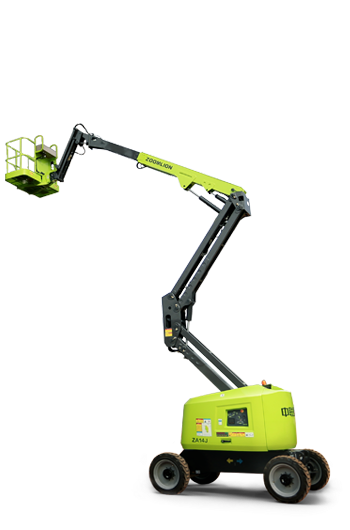
Articulating boom lifts are particularly useful where workers must access locations beyond pipes, beams, machinery, or other obstacles. Their jointed boom structure allows the platform to follow a more flexible path than a simple vertical lift. On expansive outdoor projects, this capability can support installation, inspection, finishing, and maintenance tasks at different elevations.
The Zoomlion Access ZA14J is a diesel-powered articulating boom lift designed for flexible positioning. Its maximum working height is 15.80 meters, making it a potential candidate for medium-height access tasks. Contractors should compare this figure with the actual elevation and approach angle required at each work zone, using the manufacturer’s working-envelope diagram to confirm suitability.
Match Diesel Power to Outdoor Operating Conditions
Diesel equipment is often considered for outdoor construction because refueling can be practical on sites where machines operate for extended shifts and charging infrastructure is limited. It can also suit projects that involve moving between work zones throughout the day. However, diesel power is not automatically the best choice for every outdoor application.
Procurement teams should assess expected operating hours, travel distances, refueling arrangements, noise restrictions, and emissions requirements. Sites near occupied buildings or in areas with strict environmental rules may require alternative power options. Contractors should also consider whether the equipment will ever enter enclosed or poorly ventilated spaces, where exhaust exposure can present serious hazards.
For large sites, the decision should reflect the complete work cycle rather than engine type alone. A machine that matches the terrain, access requirements, and shift schedule can help limit interruptions. Buyers should verify the manufacturer’s guidance on slopes, ground conditions, operating temperatures, and permitted driving conditions before deployment.
Evaluate Platform Capacity and Safety Systems
Platform capacity determines how much combined weight the platform can carry, including workers, tools, and materials. Contractors should estimate the maximum realistic load for their recurring tasks instead of relying on average daily requirements. Overloading can compromise stability and safe operation, while an undersized platform may force crews to make additional trips.
The ZA14J has a rated platform capacity of 300 kg. This figure provides a useful procurement benchmark, but buyers must confirm that the intended workforce and equipment remain within the rated limit. They should also review the manufacturer’s instructions for load distribution and any restrictions that apply during elevated operation.
Zoomlion Access specifies a built-in multiple-pressure-control leveling system intended to enhance stability and a precision load-sensing system designed to improve overload safety. These systems contribute to equipment control, but they do not eliminate the need for trained operators, pre-use inspections, fall-protection measures, and a site-specific risk assessment. Procurement teams should evaluate the safety documentation and maintenance requirements alongside headline specifications.
Plan for Terrain, Maneuverability, and Transport
Large outdoor sites may include compacted soil, gravel, unfinished access roads, and changing ground conditions. Buyers should check ground clearance, drive configuration, gradeability, turning radius, and tire options against the manufacturer’s specifications. These factors influence whether a machine can reach work areas efficiently, but they do not replace ground assessments or compliance with operating limits.
The ZA14J has a stowed length of 6.57 meters, width of 2.30 meters, and height of 2.27 meters. Its listed ground clearance is 0.42 meters, and its gradeability is 45%. Contractors should verify route conditions, permitted slopes, and transport requirements before delivery. The model’s dimensions also help determine whether it can pass through site entrances and maneuver around stored materials.
Compare Ownership Costs Before Purchasing
The procurement decision should extend beyond the initial price. Fuel use, routine maintenance, transportation, replacement parts, operator training, and downtime all contribute to the total cost of ownership. Contractors should compare these expenses with expected utilization and the amount of work the machine can complete during a typical shift.
When reviewing boom lifts for sale, buyers should request detailed quotations that specify the machine configuration, warranty, service arrangements, and delivery terms. They should also ask about parts availability and the maintenance schedule. A lower purchase price may not offer the best value if repairs take longer or the equipment cannot meet the project’s access requirements.
For the ZA14J, Zoomlion Access lists a 7,100 kg machine weight and a 65-liter fuel tank. The model also features an integrated rotary reducer to enhance rotation stability, a deadweight lowering system designed for smooth operation and energy efficiency, and optional hostile-environment kits for dusty conditions. Buyers should confirm the exact configuration and applicable service support with the supplier.
Make Procurement Fit the Project
Successful equipment selection starts with a clear assessment of work height, horizontal outreach, platform loads, terrain, and operating conditions. For contractors managing extensive outdoor projects, the Zoomlion Access ZA14J offers a maximum working height of 15.80 meters and a platform capacity of 300 kg. Its articulating design supports access around obstacles, subject to the manufacturer’s operating envelope.
Before committing to a diesel boom lift, contractors should verify specifications, review safety documentation, and compare expected utilization with total ownership costs. Shortlisting suitable boom lifts for sale becomes more effective when procurement teams evaluate real site tasks instead of relying on headline specifications alone. This disciplined approach helps identify equipment that meets access needs while supporting safer, more predictable project operations.